.png)
SOLUTIONS / ELECTRIC LOW-NO
Electric bus training.
Funded by your Low-No grant.
We help transit agencies move to zero-emission fleets by training drivers and maintenance teams to operate electric buses safely, efficiently, and confidently — using the workforce development funds already built into your FTA Low-No award.


5% for Training
Low-No awards set aside 5% for workforce development. We help you put it to work.

Maintenance Training
High-voltage protocols, practiced safely in VR and on mobile before touching a real bus.

Driver Training
Simulators and everyday devices teach EV essentials — anytime, anywhere.

Community Build
Member agencies share ideas and curriculum, so no one builds EV training alone.
Your Low-No grant includes funds for training and workforce development. Most agencies don’t know how to use them. We do.
ELECTRIC BUS DRIVER TRAINING
EVs change how you drive.
Electric buses don’t behave like diesel. Without the right training, agencies often see:

Rough acceleration and poor passenger comfort
Inefficient energy use and reduced range
Extra wear from improper braking technique
Driver uncertainty with new vehicle behavior

What drivers learn
01
Electric driving dynamics
-
Managing instant torque and smooth acceleration
-
Mastering regenerative braking
-
Understanding one-pedal driving
02
Energy and range awareness
-
How driving habits affect battery range
-
Route-based energy management
-
HVAC and weather effects on performance
03
Real-world scenarios
-
Urban driving, hills, grades, and passenger loads
-
Low-battery decision-making
-
Weather-related performance changes
KEY FEATURES
EV modules you’ll receive.
Essentials
EV cabin familiarity, main controls, smooth movement, and regenerative braking.
Core Skills
Turns, roundabouts, reversing, obstacle avoidance, and more.
Spatial Awareness
A challenging course that teaches the full dimensions of the bus.
Reversing
Long-vehicle reversing, with the extra cautions EVs add.
Freeway
The nuances of freeway driving in an electric coach.
Advanced
An EV-specific roadeo course with AI feedback.
vFTA Assessment
A virtual version of the real test to build confidence before the CDL.
Defensive Driving
Four zones that sharpen attention, reaction, and awareness.

Unique hazards and custom scenarios
Realistic time of day and weather conditions
Varied traffic, pedestrians, and cyclists
THE SIMULATION
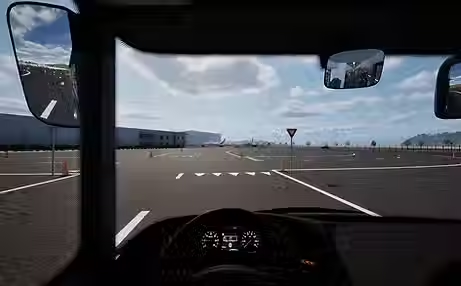
Practice real EV scenarios
without the risk.
We match bus physics to your vehicle and environments to your service area. Every view below is a real-time capture.
01 · INNOVATIVE DELIVERY
Hands-on, zero risk
Build muscle memory for EV-specific behaviors and learn faster through repetition and feedback.

02 · OUTCOMES
Results to talk about
More confident drivers, a smoother and safer ride for passengers, and better energy efficiency and range.

03 · DESIGNED TO SCALE
Grows with your fleet
Add routes and scenarios, customize for your service area, and expand into advanced EV operations.

ELECTRIC BUS VM TRAINING
The biggest gap in EV adoption: maintenance readiness.
Electric buses bring new systems and new risks. Many agencies have limited high-voltage experience, uncertainty around EV diagnostics, safety concerns for technicians, and gaps between driver reports and maintenance response. Our web, mobile, and multi-player VR training closes that gap.
01
EV systems overview
Battery architecture, electric vs. diesel drivetrain, cooling and thermal management.
02
High-voltage safety
Safe approach zones, PPE, lockout/tagout, and risk identification.
03
Inspection and awareness
What changes in EV pre-trips, what no longer applies, and early warning signs.
04
Interactive walkthroughs
Step-by-step system visualizations and scenario-based safety training.
PILOT PROGRAM
First custom VM module in about 3 months.
Because your vehicles are new, we build together. We recommend a pilot of $35k–$75k depending on your needs — targeting safety risk, operational inefficiency, range anxiety, and maintenance readiness.

HOW WE HELP
Make the most of your Low-No grant.
Many agencies win FTA Low or No Emission grants without realizing 5% of the federal funding is allocated to workforce development — so operators, technicians, and staff can safely run and maintain new electric or hydrogen fleets.
Understand the requirement
We walk you through the 5% workforce requirement and the 80/20 federal-to-local match so no funding is left on the table
A program built for your fleet
Battery-electric, hydrogen fuel cell, or hybrid — we design a learning suite around your vehicles.
A community approach
Agencies pool knowledge into standardized modules, XR experiences for any device, and a shared curriculum.
Train
Drivers on EV differences; technicians on drivetrains, batteries, and charging.
Prepare
Operators to drive zero-emission buses safely and efficiently.
Deploy
Knowledge that keeps fleets running and passengers safe.