.png)
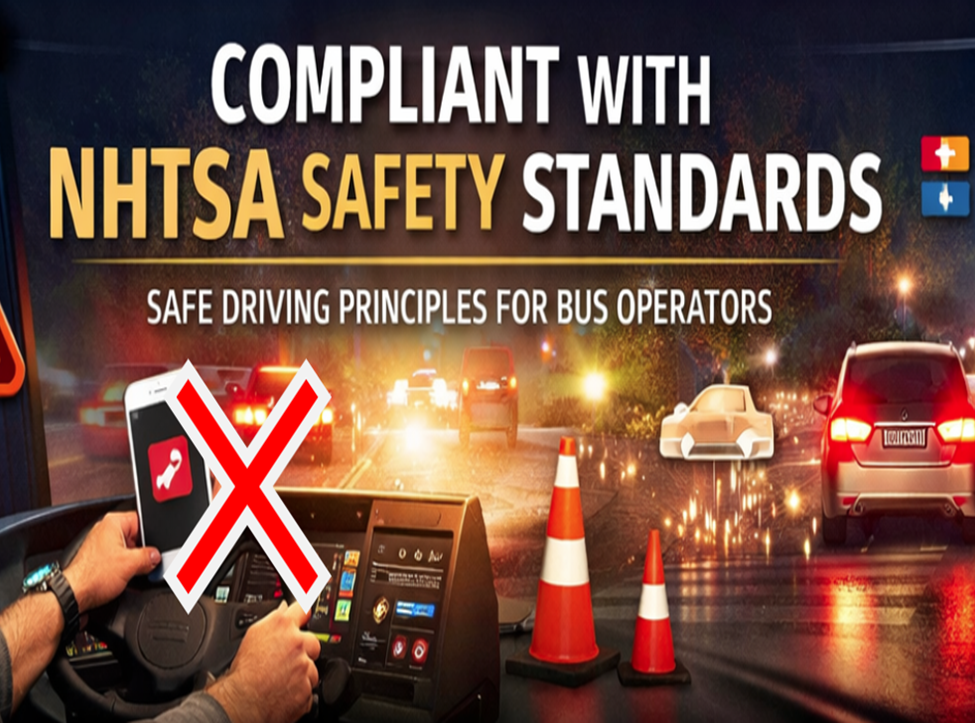
Aligning Bus Simulator Training with NHTSA’s Safe Driving Principles

While the Federal Transit Administration focuses on transit systems, the National Highway Traffic Safety Administration (NHTSA) plays a critical role in defining national safe-driving principles that apply to all vehicle operators—including professional bus drivers.
Drivers of Tomorrow designs its simulation-based training to align closely with NHTSA’s behavioral and roadway safety guidance, helping transit agencies reinforce safe driving habits that reduce collisions, injuries, and risk.

What NHTSA Emphasizes
NHTSA guidance centers on reducing roadway fatalities and serious injuries by addressing:
Speed management
Intersection safety
Pedestrian and cyclist awareness
Distracted, impaired, and drowsy driving
Hazard perception and reaction time
Adverse weather and visibility conditions
How Drivers of Tomorrow Aligns with NHTSA Principles
1. Hazard Perception and Decision-Making
DoT simulators immerse operators in realistic traffic environments where they must:
Identify emerging hazards
Anticipate the actions of other road users
Make timely, safe decisions under pressure
This supports NHTSA’s focus on human factors and crash prevention.
2. Pedestrian and Vulnerable Road User Awareness
High-fidelity traffic and pedestrian AI allows operators to train for:
Dense urban environments
High pedestrian volumes
Cyclists, scooters, and unpredictable behavior
These scenarios reinforce NHTSA’s emphasis on protecting vulnerable road users.
3. Distraction, Fatigue, and Situational AwarenessSimulation allows agencies to safely train and assess:
Attention management
Mirror use and scanning behavior
Reaction time under cognitive load
Operators experience firsthand how distraction or fatigue impacts performance—without real-world risk.
4. Adverse Weather and Reduced VisibilityDrivers of Tomorrow scenarios include:
Rain, fog, snow, and night driving
Reduced traction and longer stopping distances
Adjusted traffic behavior under poor conditions
This aligns with NHTSA guidance on adapting driving behavior to roadway and environmental conditions.
5. Post-Incident and Remedial TrainingNHTSA promotes learning from incidents to prevent recurrence. DoT supports:
Targeted retraining after collisions or near-misses
Replay and review of driving behavior
Data-driven coaching and improvement plans
Reinforcing Safe Driving—Every Day
Unlike one-time classroom sessions, simulation allows operators to practice safe driving behaviors repeatedly, building muscle memory and confidence.
By combining realistic environments, advanced physics, AI-driven traffic, and automated feedback, Drivers of Tomorrow helps agencies reinforce the safe driving principles NHTSA promotes nationwide.
Designed for Real-World Transit Operations
Importantly, DoT training is:
Instructor-led and customizable
Adaptable to local routes and policies
Scalable across experience levels and vehicle types
This ensures that NHTSA-aligned principles are taught in context, not in isolation.
For more info, reach out to hello@driversoftomorrow.com


Comments