.png)
Rail Operator Training Simulators: Immersive Training for Light Rail and Transit
Rail systems are becoming increasingly complex. Operators must manage vehicles, signals, stations, crossings, passengers, communications, changing weather, degraded conditions, and emergency situations—all while maintaining safety and schedule performance.
Traditional classroom training and on-the-job instruction remain essential, but there are situations that are difficult, expensive, or unsafe to reproduce with a real train.
That is where rail operator training simulators can make a difference.
Drivers of Tomorrow (DoT) is expanding its proven transit simulation platform into rail, bringing high-fidelity simulation, full-scale operator controls, instructor-managed scenarios, performance analytics, and immersive virtual environments to light rail and other rail operator training applications.

What Is a Rail Operator Training Simulator?
A rail operator training simulator recreates the experience of operating a train in a controlled environment.
Instead of learning only on a live rail system, operators can practice normal operations, unusual situations, and emergency procedures in a simulated environment—without the risk, operational disruption, or vehicle wear associated with live training.
A modern rail simulator can reproduce:
Train operator controls and cab layouts
Rail vehicles and vehicle dynamics
Actual routes, stations, yards, and track infrastructure
Signals, crossings, interlockings, and other infrastructure
Passenger and pedestrian activity
Weather, lighting, and visibility conditions
Equipment malfunctions and degraded operating conditions
Emergency and safety-critical events
Instructor-controlled scenarios
Operator performance and training data
The result is a training environment where operators can repeatedly practice the decisions and procedures they will need in the real world.
From Bus Simulation to Rail Simulation
Drivers of Tomorrow was founded around a simple idea: training should be as realistic as the job itself.
DoT designs and manufactures simulator hardware and develops its simulation software in-house. Our platform has been developed for public transit operator training and is designed to adapt to different vehicles, environments, and training requirements.
Our existing simulation architecture supports capabilities including:
Full-scale vehicle cab replication
Physical operator controls
High-fidelity immersive visuals
Dynamic vehicle physics
Weather and environmental simulation
Instructor-controlled scenarios
Fault and malfunction injection
Performance recording and playback
Reporting and performance analytics
Configurable route environments
Multi-station and distributed training
These capabilities provide the foundation for adapting the platform to rail vehicles and rail operating environments.
Full-Scale Rail Cab Simulation
One of the most important elements of effective simulator training is the relationship between the simulator and the real vehicle.
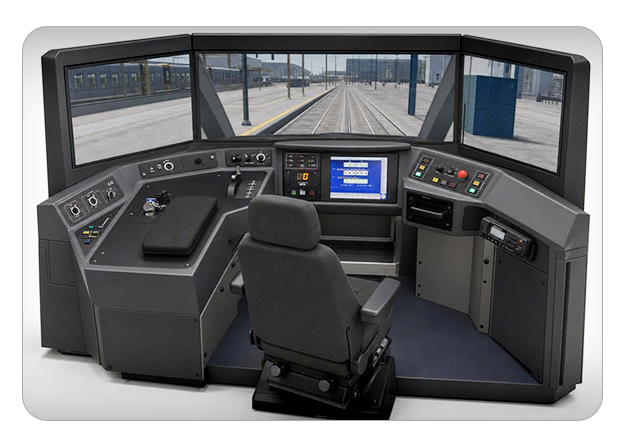
For rail applications, DoT can create a full-scale operator cab with physical controls, rather than relying entirely on touchscreen representations.
For example, our proposed LRT simulator configuration includes a full-scale operator cab, physical controls, functional displays, instructor and observer stations, and an immersive visual system.
This approach allows operators to practice the physical actions involved in operating the vehicle while simultaneously developing situational awareness and procedural knowledge.
The objective is simple: skills practiced in the simulator should transfer to the real cab.
Simulate Your Actual Rail Network
A rail simulator becomes substantially more useful when operators can train on the environment they will actually operate.
DoT's approach treats route content as configurable simulation data rather than a fixed environment. This allows individual lines, routes, infrastructure, and scenarios to be maintained and updated as the rail system changes.
That can include:
Rail corridors
Stations and platforms
Yards and maintenance areas
Tail tracks
Turnouts
Interlockings
Grade crossings
Tunnels
Elevated sections
Signals and other trackside systems
Catenary and structures
Road traffic and pedestrians
For a rail agency expanding its network, this creates an important advantage: the simulator can evolve with the system rather than becoming obsolete when the next extension opens.
Train Operators Can Practice More Than Normal Operations
A valuable rail training simulator should go well beyond simply allowing an operator to drive a virtual train from one station to another.
DoT's proposed rail simulation environment supports a broad range of training scenarios.
Normal Operations
Operators can practice:
Train handling
Station approaches and stops
Berthing
Door operation
Passenger boarding and alighting
Schedule adherence
Radio procedures
Normal revenue service
Yard and Non-Revenue Operations
Simulation can also reproduce:
Yard movements
Tail tracks
Turnouts
Interlockings
Non-revenue movements
Urban and Street-Running Operations
For systems operating through urban environments, training scenarios can include:
Grade crossings
Mixed traffic
Pedestrian conflicts
Signal compliance
Platform activity
Road traffic interactions
Degraded and Abnormal Conditions
Operators can be exposed to conditions that are difficult to reproduce safely in live service:
Signal irregularities
Equipment malfunctions
Traction power problems
Reduced adhesion
Wet, icy, or leaf-covered rail
Reduced visibility
Severe weather
Emergency Situations
Simulation can provide controlled opportunities to practice:
Emergency braking
Trespassers on the right of way
Grade crossing incidents
Evacuation decisions
Severe weather events
Other safety-critical situations
These scenarios can be created and modified by instructors, allowing agencies to build training around their own rules, procedures, infrastructure, and operational priorities.
Instructor-Controlled Training
A simulator is only as useful as the training program built around it.
DoT's instructor station gives trainers control over the simulation while a session is running. Instructors can select scenarios, introduce faults, change environmental conditions, manage sessions, and review performance.
This turns the simulator from a demonstration device into an actual training platform.
Instructors can create scenarios around specific learning objectives and then evaluate how an operator responds.
The system can also record sessions for playback and reporting, providing a much more objective way to review operator performance.

Train for the Conditions You Cannot Safely Reproduce
One of the biggest advantages of simulation is the ability to expose operators to difficult situations repeatedly and safely.
Imagine being able to train an operator for Heavy snow.
Then repeat the exercise with reduced visibility.
Then introduce a signal irregularity.
Then add a pedestrian conflict.
Then require an emergency stop.
The operator can practice the correct response without putting passengers, equipment, instructors, or the public at risk.
DoT's simulation platform supports dynamic weather, lighting, physics, emergency scenarios, and abnormal operating conditions.
Measure Performance, Not Just Training Hours
Modern operator training should be measurable.
A rail simulator can capture training sessions and provide instructors with data for evaluation, playback, reporting, and remediation.
Instead of simply documenting that an operator completed a training session, agencies can evaluate how the operator performed.
That can support:
Initial qualification
Remedial training
Performance evaluation
Continuing education
Instructor coaching
Scenario-based assessment
Documentation and reporting
DoT's platform is designed to support the operator lifecycle from initial qualification through continuing development, and can work on multiple types of devices allowing anytime anywhere training.

Networked and Multi-Operator Rail Training
Rail operations are inherently interconnected.
The actions of one operator can affect another train, a station, a crossing, or the broader network.
DoT's architecture can support networked multi-operator simulation, allowing multiple operators to participate in a shared virtual environment and coordinated scenarios.
This creates possibilities for more advanced training involving:
Multiple trains
Coordinated incidents
Traffic conflicts
Dispatch and operator interactions
Shared infrastructure
Network disruption scenarios
Additional trainee stations and distributed training can also be incorporated as a system grows.
A Rail Simulator That Can Grow With Your Agency
Rail infrastructure changes.
Routes are extended. Stations are added. Vehicles are replaced. Operating procedures evolve.
A simulator should not require an agency to start over every time its system changes.
DoT's approach separates the simulation platform from configurable route and scenario content, allowing new segments and alignment changes to be incorporated through software and content updates rather than requiring complete system replacement.
This creates a more scalable approach to long-term rail training.
From LRT to the Future of Rail Training
The initial focus of DoT's rail expansion is light rail and transit operator training, but the underlying technology is adaptable to a wide range of rail applications.
The same fundamental principles apply:
Realistic controls.
Realistic environments.
Realistic physics.
Realistic scenarios.
Measurable performance.
Whether an agency is looking for a light rail operator simulator, train operator training simulator, rail safety simulator, or a custom simulation environment for a specific vehicle and operating territory, DoT's platform is designed around the agency's actual training requirements.
Why Drivers of Tomorrow?
DoT combines the capabilities of a simulator manufacturer, software developer, and training technology provider.
Rather than purchasing hardware from one company, software from another, and training content from a third, DoT designs, builds, installs, and supports the simulator as an integrated system.
That means agencies can work with one team for:
Simulator hardware
Simulation software
Vehicle modeling
Route development
Scenario development
Instructor tools
Installation
Training
Support
Future updates and expansion
Our broader platform has been developed to support multiple transportation environments, with an architecture designed to adapt to new vehicle types while maintaining consistent standards for realism, instructor control, performance assessment, and trainee engagement.

Looking for a Rail Training Simulator?
Drivers of Tomorrow is developing the next generation of immersive rail operator training solutions for transit agencies and other rail organizations.
Whether you need a full-scale LRT simulator, a train operator simulator, a custom rail training environment, or a more flexible VR-based training solution, we can work with your team to determine the right combination of hardware, software, route simulation, and training content.
Have a rail training challenge you'd like to simulate?
Contact Drivers of Tomorrow to discuss your requirements and explore what a customized rail training simulator could look like for your organization.
Want more info? Check out our webpage https://www.driversoftomorrow.com/light-rail-operator-training
Comments