.png)
A Workforce That Isn’t Growing - It's Rapidly Turning Over

Updated: Aug 24
According to the U.S. Bureau of Labor Statistics:
Total U.S. bus drivers (2024): ~546,100
Projected total (2034): ~553,800
Growth rate: ~1%
At first glance, the workforce appears stable. But that headline number masks a critical reality: nearly all hiring demand is replacement-driven, not growth-driven.
Multiple factors are impacting transit agencies and their ability to maintain enough workers:
The Real Story: 800,000+ Drivers Must Be Replaced
Despite minimal job growth, the industry faces massive turnover:
~81,800 bus driver openings per year
~818,000 openings over 10 years (2024–2034)
To put that in perspective, the industry must recruit ~1.5× its entire current workforce in just one decade, simply to maintain existing service levels.
This is not a temporary shortage. It’s a systemic workforce reset.
The Retirement Wave Is Already Here
At the core of the shortage is a demographic reality: nearly half of all bus drivers are already over 55. This means a large portion of today’s workforce will reach retirement age within the next 5–10 years.

Transit Agencies Are Beginning to Adapt
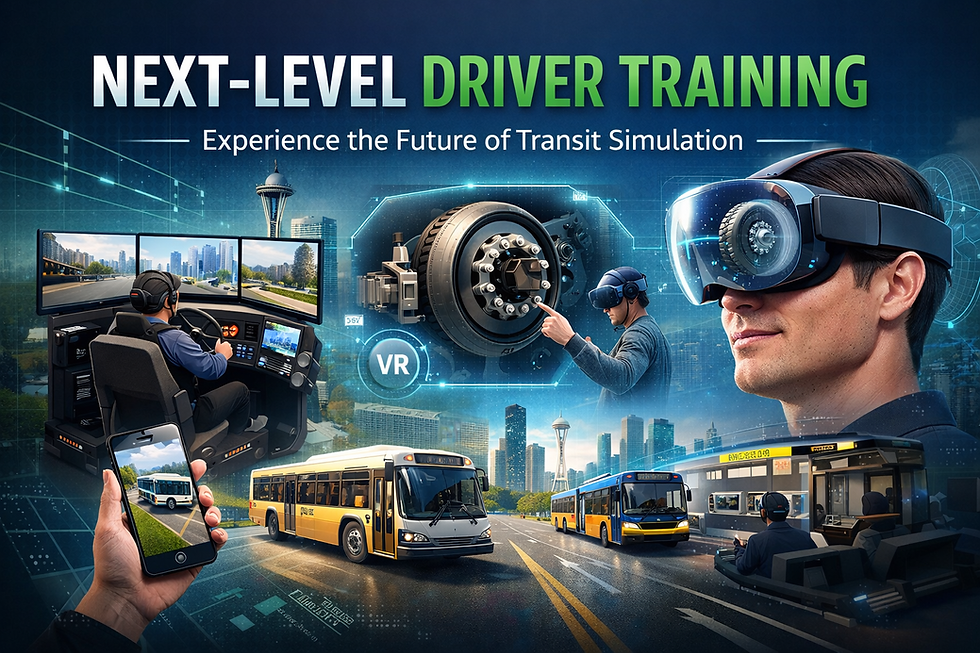
Transit agencies that have started embracing technological training solutions are already seeing significant results. They are scaling their workforce development in ways that traditional programs simply can't. With the implementation of driving simulators and virtual reality platforms, agencies are training drivers faster and at a much larger scale.
These tools help minimize reliance on limited instructor availability. They ensure standardized training experiences across every class. Trainees receive more effective learning tools, including the ability to safely practice high-risk and complex scenarios in a controlled, risk-free setting. This approach improves both confidence and pass rates before they ever operate a bus in service.
How Drivers of Tomorrow Can Help

Navigating the demands of an evolving training landscape might seem daunting, but it's what Drivers of Tomorrow does best. Whether utilizing mixed reality to reduce costs and expedite training or developing digital recreations of real-world scenarios for safer, more immersive learning, DoT has led the way for modern driver experiences, training, and immersive solutions.
The impact is clear: our clients consistently achieve bigger savings, higher pass rates, and better-prepared drivers.
Because the future of transportation won’t be solved by hiring alone. It will be solved by training differently.
The Future of Transit Training
As we look ahead, it’s crucial to understand that the landscape of transit training is changing. The need for innovative solutions is more pressing than ever.
Embracing Technology
Technology is reshaping how we train drivers. From virtual reality to advanced simulators, these tools offer immersive experiences. They allow trainees to face real-world challenges in a safe environment. This not only builds confidence but also enhances skills.
Building a Sustainable Workforce
To build a sustainable workforce, agencies must focus on retention. This means creating an environment where drivers feel valued. Offering competitive pay, benefits, and opportunities for growth can make a significant difference.
Attracting New Talent
Attracting new talent is essential. Agencies need to market the benefits of being a bus driver. Highlighting the importance of public service and the impact drivers have on their communities can draw in new recruits.
Continuous Improvement
Lastly, continuous improvement is vital. Agencies should regularly assess their training programs. Gathering feedback from trainees can help refine methods and ensure they meet the evolving needs of the workforce.
By focusing on these areas, transit agencies can better prepare for the future. The challenges are significant, but with the right strategies, we can build a stronger, more resilient workforce.
In conclusion, the transit industry is at a crossroads. We must adapt to the changing landscape. By embracing new training methods and focusing on retention, we can ensure a bright future for transit.
Let’s work together to revolutionize transit bus operator training. The future is bright, and it starts with us.
Comments