.png)
How do you Help Operators Know the Route Before They Drive It? (hint Rapid Route Training)

Updated: Sep 2
For a new transit operator, learning to drive the vehicle is only part of the challenge. They also need to learn where they're going.
Every route brings its own complexities: difficult intersections, unusual turns, busy pedestrian areas, bus-only roadways, challenging stops, restricted clearances, traffic patterns, layover locations, and hazards that may not be obvious until an operator encounters them in service.
Traditionally, much of that knowledge is gained through instructor-led route familiarization, ride-alongs, printed route information, or simply experience behind the wheel.
At Drivers of Tomorrow, we believe operators should be able to start building that knowledge before they ever drive the route in service.
That's why we've developed a scalable Virtual Route Training ecosystem with three levels of experience:
RouteView → Route360 → RouteDrive
Or, more simply:
Explore it. Experience it. Drive it.
RouteView: Explore the Route
RouteView is our most accessible approach to virtual route familiarization.
Using existing real-world mapping and imagery, we transform a transit route into a structured, interactive learning experience that operators can access through a phone, tablet, or computer.
Instead of simply looking at a map, trainees can virtually travel along the route while being introduced to important information at exactly the point where it matters.
Training can highlight:
Routes and directions
Bus stops and layover locations
Difficult intersections
Pedestrian and cyclist activity
Unusual traffic patterns
Restricted clearances
Challenging turns
Known hazards and areas of concern
Photos, video, instructions and training tips
The result is essentially an interactive guided tour of the route, designed specifically for operator training.

Because RouteView is web-based and requires no specialized training hardware, it can also be deployed at scale. An operator can explore a route in the classroom, at a training center, or independently from their own device.
The objective is simple: start learning the route before getting behind the wheel.
Route360: Experience the Entire Route
Public mapping imagery is incredibly useful, but transit vehicles don't always travel where mapping vehicles do.
Buses enter transit centers. They travel through bus-only lanes and roadways. They enter park & rides, maintenance facilities, training yards, private property, layover areas, and other restricted locations.
These can also be some of the most important places for a new operator to understand.
-> Route360 solves that problem.
We capture custom 360-degree imagery from the actual route, allowing us to extend the RouteView experience into areas where conventional street imagery isn't available.
Operators can look around the environment, understand approaches and exits, identify landmarks and hazards, and experience the route from a perspective much closer to the one they'll encounter on the job.

Route360 can include everything available within RouteView while adding:
Agency-specific 360° route imagery
Bus-only and restricted-access roads
Transit centers and facilities
Training yards
Park & rides and layover areas
Custom stops and points of interest
Hazard identification and annotations
Interactive instructional content
Optional immersive viewing
Most importantly, the training doesn't have to stop where the map stops.
It can follow the operator wherever the vehicle actually goes.
RouteDrive: Don't Just Learn the Route. Drive It.
For routes or locations where familiarity alone isn't enough, RouteDrive takes virtual route training to another level.
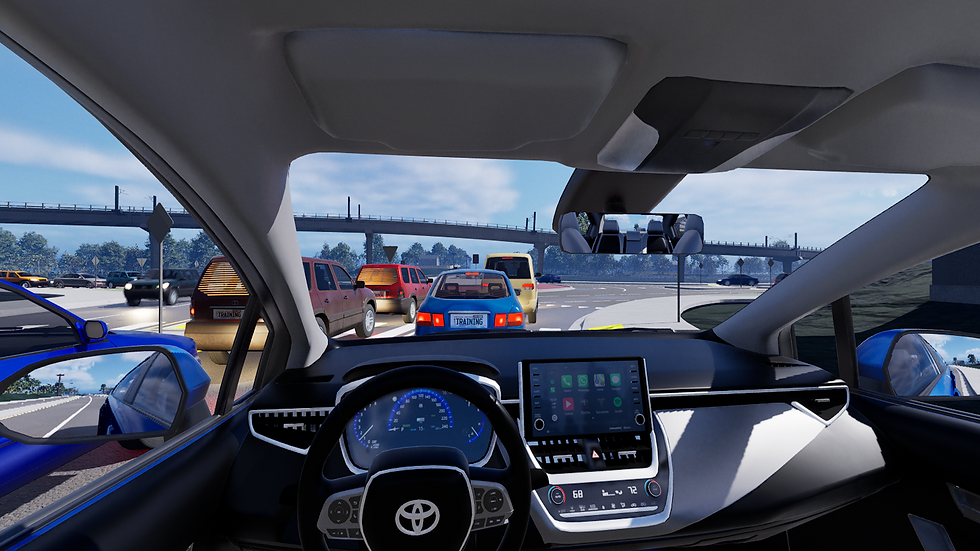
We recreate the route as an interactive 3D driving environment within the Drivers of Tomorrow simulator ecosystem.
Now the trainee isn't simply looking at the route...They're driving it.
Operators can approach real intersections, pull into stops, negotiate difficult turns, practice challenging sections, encounter hazards, and experience situations they may eventually face in service.
Because the environment is virtual, those experiences can also be controlled and repeated.

A difficult intersection doesn't need to be experienced once during a route familiarization drive. It can be practiced again and again.
A rare hazard doesn't need to happen by chance. It can be intentionally introduced.
And mistakes can become learning opportunities without putting a vehicle, passengers, instructor, or member of the public at risk.
Depending on the training objective, RouteDrive experiences can incorporate:
Fully drivable 3D route recreations
Agency-specific vehicles
Real-world road and intersection geometry
Bus stops and challenging maneuvers
Traffic, pedestrians and cyclists
Repeatable hazards and scenarios
Different traffic conditions
Weather and lighting changes
Driver performance measurement
Instructor-controlled events
Assessment and feedback
The objective evolves from route familiarization to route competency.
Operators can learn, practice, be measured, improve, and repeat.

Three Technologies. One Training Ecosystem.
RouteView, Route360 and RouteDrive are designed to work together.
An agency might use RouteView across dozens of routes, providing every new operator with convenient access to route familiarization. Route360 could then be used for routes containing transit centers, bus-only areas, unusual facilities, or locations not adequately represented by existing imagery. And RouteDrive could be reserved for the highest-risk routes, intersections, maneuvers, and locations where hands-on practice can deliver the greatest training and safety benefit.
This creates a scalable approach:
FAMILIARIZE → RECOGNIZE → PRACTICE
Rather than attempting to recreate an entire transit network at the highest level of fidelity, agencies can apply the right technology to the right training need.
Train for the Road Before Reaching the Road
Route knowledge has traditionally required time on the road. Virtual Route Training changes that equation.
New hires can begin developing route awareness before occupying a training vehicle.
Existing operators can familiarize themselves with an unfamiliar route before driving it.
Difficult locations can be reviewed before a shift. Known hazards can become structured learning opportunities.
And high-risk sections can be practiced repeatedly in simulation.
It is a complement to real-world experience (not a replacement), and is designed to help operators be better prepared and become safer drivers.
RouteView. Route360. RouteDrive.
Explore it. Experience it. Drive it.
At Drivers of Tomorrow, we're building new ways for transit agencies to prepare operators for the roads, routes, hazards, and situations they'll encounter in the real world, before they encounter them for real.
Side note, additional use cases for these Rapid Route Training tools include:
Incident Logging
Incident Route Cause Analysis
New Route Testing
Hazard Awareness
Defensive Driver Training - from anywhere
Route Knowledge Testing
Emergency Preparedness
If you have more ideas, we'd love to hear about it - contact us anytime
Interested to learn more - contact us at hello@driversoftomorrow.com

Comments